Embracing a combination of on-farm hatching and in-ovo vaccination
Both in-ovo vaccination and on-farm hatching are attracting significant interest. These innovative techniques are increasingly being applied in the broiler sector. Poultry World visited a young broiler farmer in Belgium who has been using both methods on his farm for the past 18 months and interviewed him about his motivation and experience.
This Editor’s pick is part of our premium content. You can read this article for one month for free as a gift from us. Would you like to read more articles like this? For just €4,- per month, you can have unlimited access to all our premium content.
From a young age, Jelle Moonen (27) intended to further develop the broiler activities on his parents’ farm in Deurne-Diest in Belgium. However, due to the farm’s location near nature reserves, expansion was not permitted. About 1.5 km away, they were able to acquire an existing but outdated broiler farm with the necessary permits. As a young and dynamic entrepreneur, Moonen decided to tear down the old houses and replaced them with 2 new, modern houses measuring approximately 100 by 24 metres, with a total capacity of around 80,000 chicks.
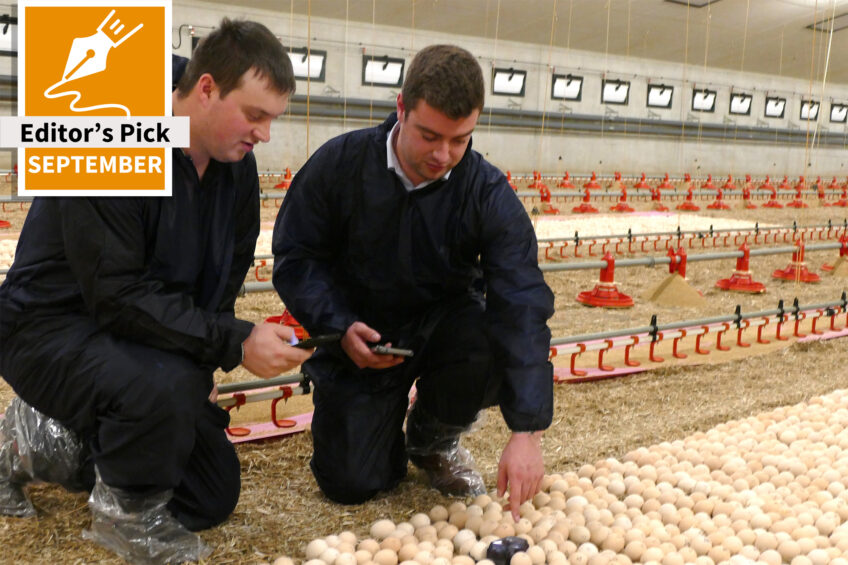
In 2022, the first flock of day-old Ross 308 broiler hatchery chicks was introduced, as is traditionally done. But because Moonen’s partner works off-farm and he also runs an arable business, he was looking for a way to manage the broiler operation more efficiently and reliably, and with minimal time spent inside the houses. The hatchery recommended an alternative technique: on-farm hatching with NestBorn. He has now successfully applied this technique for his last 8 flocks. With the NestBorn concept, the hatchery delivers 19-day-old pre-incubated and candled eggs. They are placed directly into the litter using a special egg placing machine, constructed by Viscon hatchery automation.

Motivation for NestBorn
“I prepare the house myself and set up the feeding and drinking lines, just like in the conventional approach – but in some areas I also prepare thicker litter beds to receive the pre-incubated eggs. The placement of the eggs on the litter beds is done semi-automatically, in just over an hour per house, using the specific NestBorn transfer machine, which the hatchery brings along with the eggs on day 19 of incubation. The NestBorn technique requires no additional investment in the house; it is a highly accessible concept for transitioning to on-farm hatching.”
Loggers are placed in between the eggs to monitor them 24/7 in real-time via the online NestBorn monitoring platform. “This platform relieves me from a lot of pressure, because the hatchery continuously helps me to monitor the eggshell temperature, the house climate and the hatching process. If needed, quick adjustments are possible in consultation with me. This guidance provides great peace of mind and helps to obtain excellent results in hatchability and chick quality,” according to this satisfied young broiler farmer after 8 batches.
In-ovo vaccination
“The pre-incubated eggs I obtain from the hatchery are vaccinated in-ovo against NCD, Gumboro and Marek’s disease. This frees me from having to apply spray or drinking water vaccinations, which are time-consuming and often difficult to carry out correctly. A veterinarian visit at the end of the hatching process is only still required for spraying against IB,” says Moonen.
“In the past, when all these vaccinations were carried out on-farm, a post-vaccination dip frequently occurred. With the in-ovo vaccinated and pre-incubated eggs, which I now am committed to, this phenomenon doesn’t occur anymore.” In-ovo vaccination therefore fits well with the NestBorn system to relieve pressure and offers greater reliability.

Pros and cons of on-farm hatching
One advantage of hatching on-farm is certainly that the chicks, immediately after birth and without interruption, have access to water, feed and light. They can use these assets in an unforced way, according to their needs and the time that they hatch. The chicks are remarkably calmer (as they are spared from stressful hatchery handling and subsequent transport) and they benefit from a very good start. For example, early-hatched chicks no longer have to wait up to 36 hours before drinking and eating, as is often the case with hatchery chicks.
The cycle – counting from the moment the 19-day pre-incubated eggs are received – lasts a maximum of 2 days longer in the house. To achieve the same number of cycles per year as with hatchery chicks, the turnaround time between 2 cycles must be shortened. “However, this is feasible on our farm, and we are able to meet the target of more than 7 cycles per year with a turnaround time of 7 weeks. Moreover, the shorter empty period also has an advantage: the heat loss from the house is reduced and restarting with the ideal floor temperature goes more smoothly and quickly. We are also able to manage and maintain the same level and standards of cleaning and disinfection between the cycles,“ Moonen said.

The results – green status
“Based on use of antibiotics, my farm was previously classified as an ‘orange’ farm (medium user of antibiotics) before I started applying NestBorn,” said Moonen. “We systematically needed to apply an antibiotic treatment after chick placement, which was responsible for this classification. Since the implementation of NestBorn (and in-ovo vaccination), antibiotic usage from the start to the end of each cycle has drastically decreased. We now deliver almost every flock to the slaughterhouse with zero antibiotic use, which is a much more socially acceptable way of keeping animals; much closer to consumer expectations. As a result, our farm has now been awarded the favourable green status.”
Moonen added: “I am also very satisfied with the technical results since the shift to on-farm hatching. As an example, my average flock mortality is +/-1.5% with a practice of thinning one time at 2.2 kgs (34 days) and with a final depopulation at between 2.8 and 2.9 kgs (41 days). The feed conversion ratio of the 8 cycles with the on-farm hatching (and in-ovo vaccinated chicks) ranges between 1.45 and 1.50. According to the feed company, I am in the top range of their clients.”

Cost price
“The hatchery supplies approximately 1.5% more pre-incubated eggs than the required number of day-old chicks, in order to compensate for any normal losses in hatch or first-day culls. The hatchery, Belgabroed, invoices me for the chicks present in the house after the first week and this at the prevailing day-old chick price, which suits me well, as the chick quality is better than that of a traditional hatchery chick. And the amount of extra work for me is very limited, compared to the work I have when receiving day-old chicks,” Moonen noted.
“There was no need for me to buy specific equipment, to modify my house or extra investment costs to apply the NestBorn on-farm hatching method. And finally, the confidence of the support of the NestBorn team frees me from stress, delivers high-quality chicks, and leads to clearly better technical results on my farm than with hatchery chicks. As already mentioned, the low flock mortality, the excellent technical results and the limited time I can spent in my broilers houses fits very well with my personal objectives. That’s why I have embraced both innovations for one and a half years now,” says the convinced farmer Moonen.
Join 31,000+ subscribers
Subscribe to our newsletter to stay updated about all the need-to-know content in the poultry sector, three times a week.