Joice and Hill Dekalb 500 White Egg club continues to grow
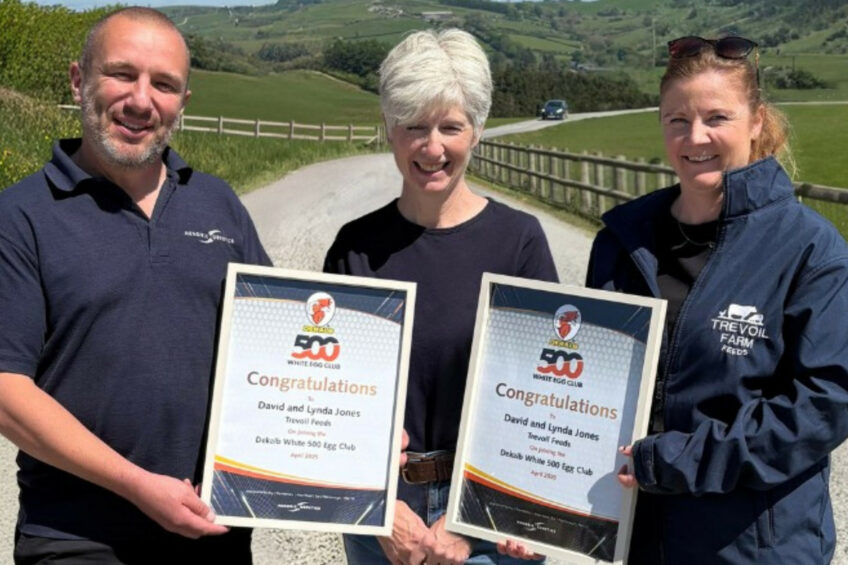
Membership of the Dekalb White 500 Egg Club has now reached more than 20 members, with the numbers of producers and flocks reaching the 500-egg mark.
In recognition of their achievement of producers who have nurtured the birds over cycles of more than 100 weeks, Joice and Hill have produced a ‘Hall of Fame’ brochure.
The company said it had launched the 500 club as a way to recognise and thank the growing band of producers who had put their faith in the Dekalb White.
Journey to an exclusively white bird operation
Among the most recent producers to join the club have been David and Lynda Jones, who farm in Powys, Wales. When their first flock arrived last September, the couple had 4 different breeds of white and brown layers on the farm. This gave them the unique opportunity to compare their performance and behaviours in a “real life experiment”. Just 3 months later they became an exclusively white bird operation.
For the couple it has been a long journey. They took their first steps into egg production, buying a Harlow 12,000 flatbed poultry house, starting out with a flock of British Blacktails. Over time the business grew and the couple now have 5 houses.
Starting out as flat decks, all but one of the sheds have been converted from a capacity of 12,000 to multi-tier units of 32,000, with the conversion of the remaining flat deck under consideration. The preferred system is Big Dutchman: “It’s rocket proof, you pay more, but it’s a stronger system and the leading system in the market,” they said.
In 2006 and 2009, 2 further houses were built for organic egg production but the organic market fell back and the sheds went back to free range after just 1 cycle. So, by 2010, all production was back to free range, with the first flock of Dekalb Whites, hatched by Joice and Hill, arriving in 2023.
The birds are easier to manage
Lynda said the white were noticeably easier to manage: “The Dekalbs came into lay much quicker and were in full production whilst the browns were just starting. Now that we have had 1 full cycle of white birds, I can say they are definitely easier, with fewer floor eggs and less dirty eggs. It makes everyone feel better including the lad that works the shed, and it allows you to spend more time looking after the birds rather than dealing with problems.”
Assistant farm manager Heather Brick said: “Spending time with the birds is so important. It’s vital to take time to recognise their normal behaviours so you can spot changes. You can tell a lot from the noise levels, and I can literally spend hours listening to bird. In the end its about husbandry and learning and common sense – you get out what you put in. For me, the Dekalb Whites definitely do give us more time to look after the birds.”
In addition to attention to detail, Lynda feels the “one big thing is water”, which is one of the most important factors in bird health. “We work with Applied Bacterial Control who put auto-flushing in all sheds, once a day before the birds get up. It ensures fresh water every morning.”
Better for producers, and the environment
The couple are convinced white birds are the way forward: “The longer cycles and fewer turnarounds have got to be better for the environment, and better for producers in financial terms, and less time spent managing issues.”
Others in the 500 Egg Club include Melcoe Park Farm, Tiverton, Devon, where the average number of eggs per hen housed at 98 weeks was 511, with one house recording an amazing 530 eggs. And Helen Ridley of Talbot Farms has recently depleted a flock of Dekalb White birds, after recording outstanding egg numbers of 542.4 egg per hen housed, over a 103-week cycle.
She said: “The Dekalb White birds, hatched by Joice and Hill, are remarkably robust and have presented noticeably fewer challenges.
Join 31,000+ subscribers
Subscribe to our newsletter to stay updated about all the need-to-know content in the poultry sector, three times a week.