How does the distribution of 2 key nutrients affect broiler performance?
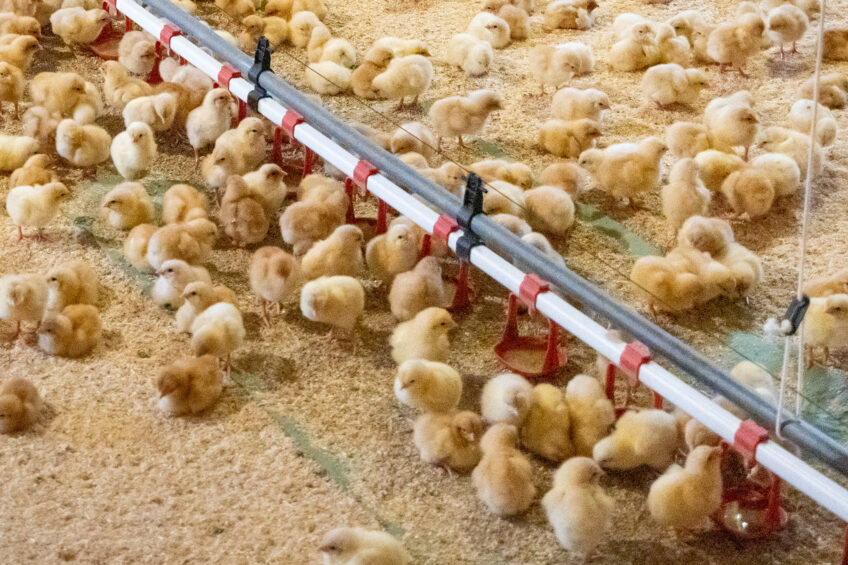
Broilers being fed in houses through long distribution lines can be affected by inconsistent feed quality, which impacts bird growth and health. Researchers at Penn State University in the US carried out a study to determine how nutrient distribution affects broiler chicken performance, processing yields and bone mineralisation.
“Walking through commercial poultry houses, and looking in the feed pans, seeing what the birds are consuming, we saw a difference in the quality of feed from the front of the house where feed was coming into the back end of the house,” said Jon Boney, fellow of poultry nutrition at the College of Agricultural Sciences.
He added: “That led us to the question: If we can see a difference in physical quality of the feed, meaning many of the pellets have broken down into fine particles or dust, how does that variability affect nutrition the birds receive?”
Key nutrients for broilers
In findings published in the Journal of Applied Poultry Research, the researchers reported that variability in 2 key nutrients along the feed line affected the broiler chickens’ growth performance, including body weight, feed-conversion ratio, processing yields, and bone strength/mineralisation.
- Amino acid density: the amount of essential amino acids, which are the building blocks for proteins, in the feed
- Phytase activity: a type of protein called an enzyme responsible for initiating and accelerating necessary biological reactions, that helps chickens absorb phosphorus from plant material.
The researchers fed young commercial broiler chickens different diets for more than 2 weeks. The diets had 2 levels of amino acid density and 3 levels of the enzyme phytase activity. To make sure the dosing was precise, the enzyme was removed at the feed mill and added later.
What did the researchers discover with the broilers?
The researchers found that birds on high amino acid density diets gained more body weight by the end of the experiment. They had better feed efficiency, which measures how effectively birds convert feed into weight gain, and they had higher breast meat yield.
On the other hand, the enzyme phytase activity had no significant effects, the researchers reported. Changing phytase levels didn’t impact growth, feed efficiency or bone health. The researchers concluded that amino acid density is a good indicator of nutrient segregation. When the density is wrong, bird growth and health suffer.
They also found that amino acid density and phytase activity didn’t interact, so observed effects could be reliably attributed to just amino acid density.
Practical applications for poultry producers
The takeaway message from the research, according to Boney, is that to assess feed-quality consistency in poultry houses (typically house 25,000 to 40,000 birds) monitoring amino acid density is more informative than monitoring the level of the enzyme phytase activity, and that feed pellet quality and feed line length can cause important nutrient inconsistencies, affecting broiler chicken growth and health outcomes.
“Feed is carefully formulated for broilers to make them grow quickly and be healthy, and as the poultry industry continues to grow, raising more and more birds, it’s important that feeding methods are consistent and uniformly effective,” Boney said.
“If we can minimise or eliminate nutrient segregation, all the birds, regardless of where they’re reared in a chicken house, have access to the same nutrients, and in theory, could grow at the same rate, making that flock more uniform in terms of size and health. So, it helps producers operating a processing plant satisfy orders,” he noted.
The research was funded by the PA Poultry Research Checkoff program and the US Department of Agriculture’s National Institute of Food and Agriculture.
Join 31,000+ subscribers
Subscribe to our newsletter to stay updated about all the need-to-know content in the poultry sector, three times a week.