How robotics can help with poultry farm management
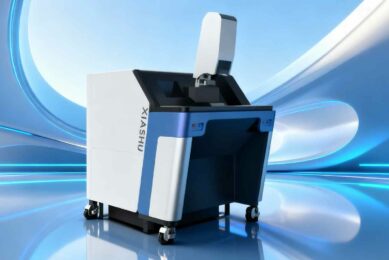
Keen to make farm inspections easier and less labour intensive, researchers have developed an autonomous robot called Poultry Patrolman. The robot is designed to move through narrow lanes in high-density stacked poultry houses and inspect the environment on its own.
The researchers from the Key Laboratory of Smart Agriculture, China Agriculture University, Bejing, used 2D LiDAR sensors to enable the robot to “see” its surroundings. The robot then converts the sensor data into a useable format and corrects for movements errors. A smart algorithm called Full Samples Consensus (F-SAC) then helps the robot detect lane edges accurately, so it knows where to travel.
The researchers were keen for the robot to stay on track and so used a special optimisation method – Collaborative Hybrid Genetic-Particle Swarm Optimisation (CHGAPSO), which fine-tunes the robot’s steering system. This is then combined with a control system (EKF-PID) that helps the robot follow its path precisely and smoothly.
What were the results?
Experimental results demonstrate that the F-SAC algorithm achieved a maximum absolute angular error of 2.328°, an average angular error of 0.116°, and a line fitting accuracy of 98.3%.
The CHGAPSO algorithm outperformed other methods in optimising control parameters across 4 trajectory types: straight line, sinusoidal curve, composite curve, and noisy straight line. And the EKF-PID control system demonstrated stable lane-following performance, consistently maintaining lateral steady-state errors within 2 cm under various initial poses at speeds of 0.2 m/s, 0.4 m/s, and 0.6 m/s.
These findings validate the effectiveness and reliability of the proposed navigation framework for autonomous poultry house inspection.
The study, ‘Lane navigation control method and equipment of chicken house based on 2D LiDAR’ is published in the Journal ‘Computers and Electronics in Agriculture’.