Brazil more than doubles egg exports in 2025
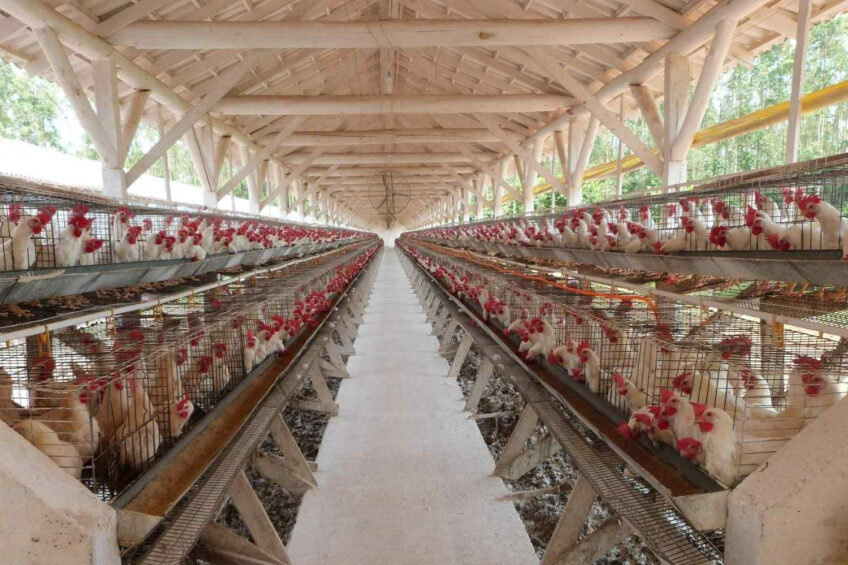
Brazil more than doubled its egg exports in 2025, reaching a historic record. The result points to an internationalisation trend in a segment that, until a few years ago, played only a marginal role within the Brazilian poultry industry.
Shipments of both fresh and processed products totalled 40,894 tonnes over the year, according to the Associação Brasileira de Proteína Animal (ABPA). This volume represents a 121.4% increase compared to 2024, when exports reached 18,469 tonnes. In terms of value, growth was even stronger, with revenue reaching US$97.24 million, a 147.5% increase from US$39.28 million the previous year.
A milestone for the sector’s internationalisation
The performance confirms a shift in the scale of foreign trade for the product. “With these volumes, exports exceeded the equivalent of 1% of total national egg production, a relevant milestone for the sector’s internationalisation, without compromising domestic supply, which continues to absorb around 99% of what is produced in the country,” says ABPA president Ricardo Santin.
According to him, the advance shows that the laying-hen industry is beginning to incorporate an export-oriented strategy, previously restricted to specific markets.
US, the top destination of egg exports
Growth, however, was not uniform throughout the year. The US led the ranking of destinations in 2025, with 19,597 tonnes, a volume 826.7% higher than in 2024. The pace slowed after the imposition of additional tariffs, forcing the sector to seek alternatives.
“The sector re-organised itself, and new destinations gained momentum, such as Japan, a high-value-added market that came to lead Brazilian shipments in the final months of the year,” Santin notes.
On an annual basis, Japan imported 5,375 tonnes, a 229.1% increase. Chile followed (4,124 tonnes), despite a contraction of 40% compared with the previous year. Mexico and the United Arab Emirates complete the list of main buyers, at 3,195 tonnes (+495.6%) and 3,097 tonnes (+31.5%), respectively, reinforcing the geographical diversification of exports.
Stable supply keeps egg prices low
Despite the expansion in exports, the impact on the domestic market was limited. Most production continued to be directed towards internal consumption, helping to explain price behaviour at the start of 2026.
A survey by the Centre for Advanced Studies in Applied Economics (Cepea) showed that, in January, average egg prices reached their lowest level for the month since 2020 in several monitored regions. Up to the end ofJanuary, prices were 17% lower than in December 2025 and 27% below those recorded a year earlier, in real terms.
In the Bastos region of São Paulo state, the country’s main production hub, the average price of extra-large white eggs was R$105.57 per 30-dozen box (around US$20.08), representing a real decline of 12% month-on-month and 24.8% year-on-year.
For brown eggs traded in the same market, the average price was R$118.76 per box (about US$22.57), 11% lower than in the previous month and 27.3% below January 2025, also in real terms. In both cases, these are the lowest averages for the month of January in 6 years.
Seasonal trends boost egg consumption
For ABPA, the combination of consolidated exports and seasonal factors is expected to shape the market in the coming months. “With a more structured export culture, the expectation is that export flows will be maintained at positive levels,” Santin says.
According to him, higher temperatures at the beginning of the year and the approach of Lent — a period traditionally associated with increased egg consumption — should contribute to balancing supply in the domestic market.
The sector enters 2026 seeking to reconcile 2 objectives: expanding its presence abroad without putting pressure on prices for Brazilian consumers.
Join 31,000+ subscribers
Subscribe to our newsletter to stay updated about all the need-to-know content in the poultry sector, three times a week.